
Does the shock absorber reduce power?
In HVAC and refrigeration system projects, particularly those utilizing high-pressure refrigerants like R410A, a seemingly simple yet persistent challenge often emerges during procurement:
Will removing the shock absorber affect the system's power?
This issue is no accident. The R410A system inherently operates under high pressure and heavy compressor loads, making any additional component potentially suspect of "increasing resistance" or "slowing efficiency." For procurement teams, such concerns stem not from technical nitpicking but from project experience—any efficiency drop amplifies energy consumption, noise, and failure rates. Yet the real differentiator isn't "whether to install dampers," but "what kind of dampers to install."
1. Why R410A systems are more prone to accusations of 'power consumption'
Let's start with a basic fact.
R410A is a high-pressure refrigerant, and in typical air conditioning and refrigeration applications, the system operating pressure is significantly higher than that of conventional refrigerants. Under actual operating conditions, the system pressure typically exceeds 13 bar, reaching up to 44.8 bar (650 psig) under high load and specific model conditions. At such pressure levels, any improperly designed piping fittings can directly affect fluid flow capacity. Many purchasers have indeed encountered similar issues in early-stage projects:
The inner diameter of the damper is designed conservatively, sacrificing flow area for strength
Complex internal structure with discontinuous flow channels
Use low-grade bellows, relying on "thickness" for pressure resistance
The outcome was that during the system testing phase, no issues were apparent. However, after prolonged operation, the compressor's efficiency declined while noise levels increased significantly, ultimately leading to the mistaken conclusion that' the vibration damper was hindering performance.'
2. The shock absorber itself is not designed to "consume power"
From a system perspective, the shock absorber is installed at the intake and exhaust pipe positions. Its primary function isn't to alter flow rate, but to address two key issues:
Mechanical Vibration of Compressor
Stress Concentration of Pipeline Due to Temperature Change
If these two problems persist for a long time, the consequences are usually not "increased motivation", but:
fatigue of pipe weld
leakage at the joint
System noise continues to increase
shortened life of compressor
In other words, the real factor affecting the system's long-term stability is either the absence of installation or improper installation.
3. R410A High-Pressure Dampers: Structural Differences Matter More Than the Name
In high pressure system, whether the damper can "not eat power" depends largely on the internal structure and material system.
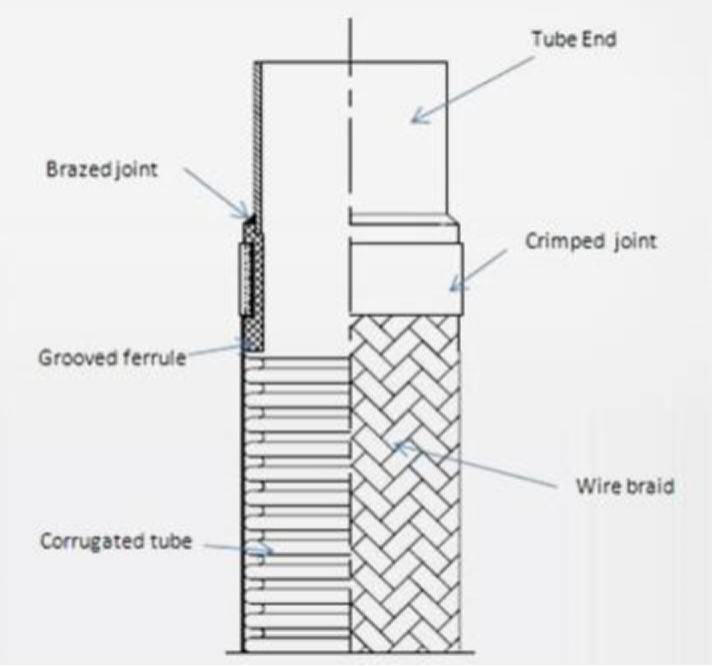
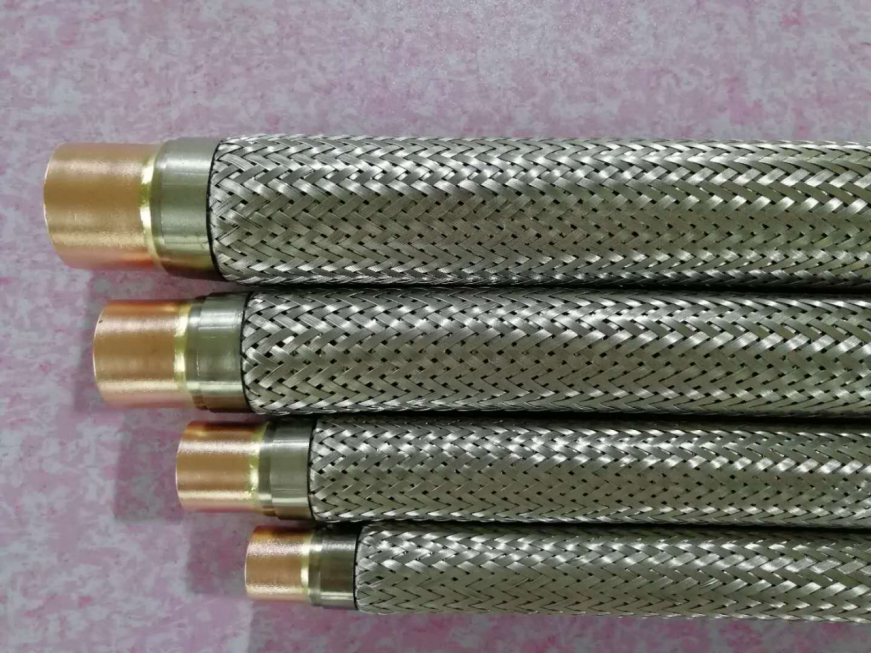
The R410A high-pressure damper, for instance, features a core structure with deep-spaced stainless steel bellows.
The direct advantage of deep clearance design is maintaining relatively smooth flow channels while withstanding high pressure, eliminating the need for diameter reduction to enhance strength. This is particularly crucial in the operational range of 13–44.8 bar.
The outer layer employs a high-strength steel wire braided layer, which is not merely a simple covering but is mechanically clamped and fixed using a high-pressure clamping machine. At both end interfaces, stainless steel sleeves are uniformly welded with TIG welding to minimize potential hazards caused by weld defects.
The purpose of this structural combination is only one:
Under high pressure, the strength is guaranteed without sacrificing the flow rate.
4. The Sealing Problem Is the "Hidden Cost" That Procurement Really Care About
The R410A system has very realistic requirements for sealing.
Even a minor leak under high-pressure conditions can rapidly escalate, ultimately triggering a cascade of issues including reduced refrigeration efficiency, refrigerant replenishment, and shutdown maintenance.
To address this, the high-pressure damper is designed with flexibility in its selection process.
Each connection end can be designed with a stopper structure
Reducing Sealing Fatigue Caused by Vibration and Displacement
Reducing the leakage probability after long-term operation
More importantly, each shock absorber undergoes a dual test of 100% helium leak detection and hydraulic leak detection before leaving the factory, rather than random sampling. This practice is uncommon in batch supply, but it represents a highly practical risk control measure for high-pressure systems.
In terms of certification, the product has obtained UL and CE certifications. Some models feature UI certifications with a burst pressure of up to 224 bar (3250 psig), significantly exceeding the system's actual operating pressure. Such data carries more weight than verbal commitments in engineering projects.
5. Temperature and medium compatibility determine the applicable scope
From a procurement perspective, adapting to a single project is straightforward, but achieving cross-project compatibility is the real challenge.
The R410A high-pressure damper operates within a temperature range of-40℃ to +120℃, adaptable to diverse regions, seasons, and system configurations.
The product also demonstrates excellent compatibility with various refrigerants and lubricants, significantly reducing additional validation costs caused by medium changes.
During the factory release process, each device undergoes cleaning, dehydration, and film sealing after final inspection, then is individually packed into boxes. Such details are typically only repeatedly emphasized when undertaking long-term projects.
6、Does the Damper Reduce Power?
Back to the original question.
In practical applications, high-voltage dedicated vibration dampers do not 'reduce power'; instead, they help maintain system stability during prolonged operation. After vibration is controlled:
The pipeline stress is more uniform.
The noise level has decreased.
The compressor operates more smoothly.
From the perspective of energy consumption, the system loss has not increased due to the addition of shock absorbers, but rather has decreased the hidden losses caused by vibration, leakage, and structural fatigue.
7. The Key Points from the Perspective of Procurement Are Actually Clear
For buyers, the real question isn't whether to install shock absorbers, but rather:
Is it specifically designed for the R410A high-pressure system?
Can it operate continuously under 13–44.8 bar conditions?
100% verified by actual measurement
Does it have clear authentication and parameter support
Under these conditions, the shock absorber is no longer a burden to the system, but a part of the stable operation.
8. Supply and Customization Capability, Also a Part of Project Decision-making
In real-world projects, the ability to deliver is just as important.
Our R410A high-pressure dampers deliver a stable daily output of 1,000 units while supporting OEM customization. The interface configuration, length, and structural details can be tailored to system requirements, a key advantage for mass production projects.
In the R410A high-pressure system, shock absorbers are neither optional accessories nor the primary culprit for power consumption. The true determinants of system performance are structural rationality, material compatibility, and thorough testing.
Selecting the right high-pressure damper ensures stable system operation and reduces maintenance costs.
This isn't a marketing conclusion, but a practical assessment drawn from numerous projects after long-term operation.
For more details about parameters or applications, you can
Emali: honway_hvac@hotmail.com
Phone: +86-24-23882750,+86-18602456896